


UN declares Internet access a human right
As evidenced by the Facebook Revolutions and ensuing Middle East turmoil, the Internet is a powerful tool and one capable of change. Of course, its eliminating citizen use of the Web under oppressive regimes has also yielded consequences. Perhaps inspired by these effects, the UN has declared the Internet a human right. A recent report titled "Report of the Special Rapporteur on the promotion and protection of the right to freedom of opinion and expression" declares that Internet access falls under freedom of expression.
"The unique and transformative nature of the Internet not only [enables] individuals to exercise their right to freedom of opinion and expression, but also a range of other human rights, and to promote the progress of society as a whole." Special rapporteur Frank La Rue also acknowledges that the Web has become too important a tool to asserting other human rights for people to be denied its use. "Given that the Internet has become an indispensable tool for realizing a range of human rights, combating inequality, and accelerating development and human progress, ensuring universal access to the Internet should be a priority for all states."
While the report may have especially poignant significance for Middle Eastern nations, it applies internationally. "Each state should thus develop a concrete and effective policy to make the Internet widely available, accessible, and affordable to all segments of population." The US National Telecommunications and Information Association (NCIA) are collaborating with the FCC to analyze the state of broadband availability in the country. Recent findings revealed that a five to 10 percent of American cannot access Internet speeds that allow basic Web functions. So if you think this is merely a third-world problem or issue with oppressive governments, you´d be wrong.
Of course, these events are why such a policy has become relevant: "The recent wave of demonstrations in countries across the Middle East and North African region has shown thekey role that the Internet can play in mobilizing the population to call for justice, equality,accountability and better respect for human rights. As such, facilitating access to theInternet for all individuals, with as little restriction to online content as possible, should be apriority for all States."
But is anything going to come out of this report? Last year, a BBC World Service study found that four out of five adults thought Internet access was a fundamental right, and participants from China, Mexico, Nigeria, Brazil, and South Korea were just among some of the countries that majorly agreed with this. Which means that despite these largely held beliefs, opponents are still denying people this alleged right.
www.telecomcomments.com

UN declares Internet access a human right
As evidenced by the Facebook Revolutions and ensuing Middle East turmoil, the Internet is a powerful tool and one capable of change. Of course, its eliminating citizen use of the Web under oppressive regimes has also yielded consequences. Perhaps inspired by these effects, the UN has declared the Internet a human right. A recent report titled "Report of the Special Rapporteur on the promotion and protection of the right to freedom of opinion and expression" declares that Internet access falls under freedom of expression.
"The unique and transformative nature of the Internet not only [enables] individuals to exercise their right to freedom of opinion and expression, but also a range of other human rights, and to promote the progress of society as a whole." Special rapporteur Frank La Rue also acknowledges that the Web has become too important a tool to asserting other human rights for people to be denied its use. "Given that the Internet has become an indispensable tool for realizing a range of human rights, combating inequality, and accelerating development and human progress, ensuring universal access to the Internet should be a priority for all states."
While the report may have especially poignant significance for Middle Eastern nations, it applies internationally. "Each state should thus develop a concrete and effective policy to make the Internet widely available, accessible, and affordable to all segments of population." The US National Telecommunications and Information Association (NCIA) are collaborating with the FCC to analyze the state of broadband availability in the country. Recent findings revealed that a five to 10 percent of American cannot access Internet speeds that allow basic Web functions. So if you think this is merely a third-world problem or issue with oppressive governments, you´d be wrong.
Of course, these events are why such a policy has become relevant: "The recent wave of demonstrations in countries across the Middle East and North African region has shown thekey role that the Internet can play in mobilizing the population to call for justice, equality,accountability and better respect for human rights. As such, facilitating access to theInternet for all individuals, with as little restriction to online content as possible, should be apriority for all States."
But is anything going to come out of this report? Last year, a BBC World Service study found that four out of five adults thought Internet access was a fundamental right, and participants from China, Mexico, Nigeria, Brazil, and South Korea were just among some of the countries that majorly agreed with this. Which means that despite these largely held beliefs, opponents are still denying people this alleged right.
www.telecomcomments.com
UN declares Internet access a human right
As evidenced by the Facebook Revolutions and ensuing Middle East turmoil, the Internet is a powerful tool and one capable of change. Of course, its eliminating citizen use of the Web under oppressive regimes has also yielded consequences. Perhaps inspired by these effects, the UN has declared the Internet a human right. A recent report titled "Report of the Special Rapporteur on the promotion and protection of the right to freedom of opinion and expression" declares that Internet access falls under freedom of expression.
"The unique and transformative nature of the Internet not only [enables] individuals to exercise their right to freedom of opinion and expression, but also a range of other human rights, and to promote the progress of society as a whole." Special rapporteur Frank La Rue also acknowledges that the Web has become too important a tool to asserting other human rights for people to be denied its use. "Given that the Internet has become an indispensable tool for realizing a range of human rights, combating inequality, and accelerating development and human progress, ensuring universal access to the Internet should be a priority for all states."
While the report may have especially poignant significance for Middle Eastern nations, it applies internationally. "Each state should thus develop a concrete and effective policy to make the Internet widely available, accessible, and affordable to all segments of population." The US National Telecommunications and Information Association (NCIA) are collaborating with the FCC to analyze the state of broadband availability in the country. Recent findings revealed that a five to 10 percent of American cannot access Internet speeds that allow basic Web functions. So if you think this is merely a third-world problem or issue with oppressive governments, you´d be wrong.
Of course, these events are why such a policy has become relevant: "The recent wave of demonstrations in countries across the Middle East and North African region has shown thekey role that the Internet can play in mobilizing the population to call for justice, equality,accountability and better respect for human rights. As such, facilitating access to theInternet for all individuals, with as little restriction to online content as possible, should be apriority for all States."
But is anything going to come out of this report? Last year, a BBC World Service study found that four out of five adults thought Internet access was a fundamental right, and participants from China, Mexico, Nigeria, Brazil, and South Korea were just among some of the countries that majorly agreed with this. Which means that despite these largely held beliefs, opponents are still denying people this alleged right.
www.telecomcomments.com
La Comisión lanza el Smart Cities Index
En 2005 durante la II Cumbre Mundial de Ciudades y Autoridades Locales sobre la Sociedad de la Información celebrada en Bilbao, las Autoridades Locales presentes, se comprometieron a trabajar para la consecución del pleno acceso a la Sociedad de la Información en sus ciudades y regiones a través de la implementación de Agendas Digitales Locales, una estrategia electrónica local para el desarrollo de la Sociedad de la Información en una región. Por ello, su diseño y desarrollo será similar a cualquier Plan Estratégico Sectorial, coordinado e integrado con el Plan Estratégico Local de una ciudad o una región.
Ahora, pasados más de 5 años, llega el momento de hacer un balance. Desde la Comisión de Ciudades Digitales y del Conocimiento de CGLU queremos impulsar la realización de un estudio, para conocer el grado de avance de los miembros de CGLU con respecto a las TIC, Innovación y conocimiento y de esa manera poder establecer indicadores de seguimiento, que nos permitan conocer si estamos trabajando en la línea adecuada de alcanzar ciudades/municipios más competitivos.
Animamos a los miembros de la Comisión y de CGLU a que contribuyan al estudio, cumplimentando el siguiente formulario on-line de recogida de información antes del 15 de julio de 2011.

En caso de tener algún problema para acceder a la versión on-line del formulario, puede descargarselo en el siguiente enlace:
Descargarse Formulario de Recogida de Datos
Descargarse Anexo: Presentación de buena práctica
En caso de tener algún problema para acceder al formulario ó cualquier duda, póngase en contacto con el Secretariado de la Comisión en el E-mail bilbaonext.promocion@ayto.bilbao.net ó en el teléfono: +34 94 423 5049
The Committee launches the Smart Cities Index
In 2005 during the II World Summit of Cities and Local Authorities on the Information Society held in the City of Bilbao, the local authorities committed themselves to work to achieve a full access to the Information Society in their cities and regions through the implementation of the Digital Local Agendas, a local strategy for the development of the Information Society in a region.
Now, after more than 5 years, the moment has come to make a balance. For this reason, the Committee of Digital and Knowledge Based Cities wants to support the completion of this study, so that it can constitute a starting point to know about the real state of the art referring to ICTs, Innovation and Knowledge in the Committee, and we can be able to establish some indicators that can allow us to know whether we are working in the right direction in order to achieve more competitive cities.
We encourage the Committee members and UCLG members to contribute to this study by filling the following on-line formulary before the 15th of July 2011.

In case you have any problem accessing the on-line version of the form, you can download it in the following link:
In case you have any problem to aces the formulary or you have any question, do not hesitate contacting the Committee Secretariat in the Email bilbaonext.promocion@ayto.bilbao.net or telephone: +34 94 423 5049
La Commission lance le Smart Cities Index
En 2005 pendant le Sommet Mondial des Villes et Autorités Locales sur la Société de l´Information tenu à Bilbao, les Autorités Locales présentes se sont engagées à travailler pour la réalisation du plein accès à la Société de l´Information dans leurs villes et régions à travers l´implémentation d´Agendas Numériques Locales, une stratégie locale pour le développement de la Société de l´Information dans une région. Pour cette raison, sa conception et développement sera semblable à tout Plan Stratégique Sectoriel, coordonné et intégré avec le Plan Stratégique Local d´une ville ou d´une région.
Maintenant, après plus de 5 années, arrive le moment de faire un bilan. Depuis la Commission de Villes Numériques et de la Connaissance de CGLU nous voulons promouvoir la réalisation de c´étudie, pour connaître le degré de progrès des membres de CGLU en ce qui concerne les TIC, l´Innovation et la connaissance et de cette manière pouvoir établir des indicateurs de suivi qui nous permettent de savoir si nous travaillons dans la ligne adéquate pour obtenir des villes plus compétitives.
Nous encourageons aux membres de la Commission et de CGLU à contribuer à l´étude, en remplissant le suivant formulaire en ligne de récolte d´information avant le 15 juillet 2011.

Si vous avez des problèmes avec l´accès à la version enligne, vous pouvez le déchargeur dans le lien suivant :
Décharger Formulaire de récolte de données
En ayant des problèmes pour accéder au formulaire ou quelque question, n´hésite pas de contacter le Secrétariat de la Commission dans l´E-mail bilbaonext.promocion@ayto.bilbao.net ou dans le téléphone : +34 94 423 5049
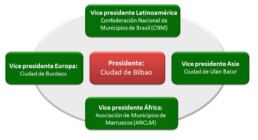
Renewal of the Vice-presidencies of the Committee
As it was informed during the Committee meeting held in the City of Mexico un November 17th, 2010, during the first quarter of 2011 from the Presidency of the Committee we have carried out a renewal process of the Vice-presidencies of the Committee.
In the case of the Committee Vice-presidencies for Euro-Asia, Latin America and Africa held by the City of Ulan Bator, the National Confederation of Municipalities of Brazil (CNM), and the Association of Municipalities of Morocco (ANCLM) respectively, we are pleased to inform you that they have confirmed the renewal of their commitment to continue to leader and coordinate the work of the committee in their region.
In the case of the Vice-presidency of Europe, held by the City of Stuttgart, we were informed that it was not possible for them to keep on holding the position of Vice-president of the Committee of Digital and Knowledge-based Cities for the region of Europe.
With the objective to continue having a geographical balance in the Committee Government bodies, the City of Bordeaux in France has accepted the commitment of holding the Vice-presidency of the Committee for the region of Europe. The City of Bordeaux has broad experience in the development of the Information Society in its Territory.
Through its "Bordeaux Digital City" programme implemented in 2010, the City of Bordeaux has developed diverse digital initiatives in the city: development of services accessible through mobile internet, interactive blackboards in the schools, new web pages for the museums such as the CAPC developed with free software, implementation of 2D codes in the city that give additional information to the citizens, development of a pilot experience with more than 100 families in which they receive a computer connected to high speed internet and a training offer, launch of an extensive consulting platform, use of social networks to have a closer relation with the citizens in the fame work of the "solidary neighbors" project, development of public wifi points... in summary, a group of innovative services, that help to improve the quality of live of the Citizens.
From the Presidency of the Committee we thank the commitment acquired by the Vice-presidents and we are sure that together, with the support of the Committee members, we will be able to keep on working to reach more competitive cities and municipalities through the use of ICT, innovation and knowledge-management.
Renouvellement des Vice-présidentes de la Commission
Comme on a informé pendant la réunion de la Commission tenue dans la Ville du Mexique le 17 novembre 2010, pendant le premier trimestre de 2011 depuis la Présidence de la Commission on a développé un processus de rénovation des Vice-présidentes de la Commission.
Dans le cas des Vice-présidentes de la Commission par l´Euro-Asie, l´Amérique latine et l´Afrique portées par la Ville d´Ulán Bator, la Confédération Nationale des Communes du Brésil (CNM) et l´Association des Communes du Maroc (ANCLM) respectivement, nous sommes contentes de vous informer qu´ils ont confirmé la rénovation de son compromis de continuer à leader et coordonner le travail de la commission dans sa région.
Dans le cas de la Vice-présidence par l´Europe, portée par la Ville de Stuttgart, ils nous ont communiqué que malheureusement c´est pas possible pour lui de continuer à porter le poste de Vice-président de la Commission de Villes Numériques et de la Connaissance par la région de l´Europe.
Dans le but de continuer à maintenir un bilan géographique dans les organes de Gouvernement de la Commission, la Ville de Bordeaux en France a accepté le compromis de porter la Vice-présidence de la Commission par la région de l´Europe. La Ville de Bordeaux compte avec une vaste expérience dans le développement de la Société de l´Information dans son territoire.
A travers « Bordeaux cité digitale » programme lancé en 2010, la Ville propose de nombreuses initiatives numériques : services accessibles par Internet mobile, tableaux interactifs dans les écoles, nouveaux sites pour les musées comme le CAPC, conçus sur logiciel libre, codes 2D dans la ville apportant des compléments d´information aux citoyens, expérimentation sur 100 familles d´une mise à disposition d´un ordinateur connecté à haut débit et d´une offre de formation, lancement d´une vaste plateforme de consultation, usage des réseaux sociaux pour plus de proximité dans le cadre du projet "voisins solidaires", développement des points d´accès publics à Internet... un bouquet de services innovants, pour une vie meilleure dans la cité digitale.
Depuis la présidence de la Commission nous remercions le Compromis des Vice-présidents et nous sommes sûrs qu´ensemble et avec l´appui de tous les membres de la Commission, nous pourrons continuer à travailler pour atteindre des villes et des communes qui par l´utilisation des Nouvelles technologies, l´innovation et la gestion de la connaissance, améliorent la qualité de vie de la citoyenneté et soient plus compétitives.
Renovación de las Vicepresidencias de la Comisión
Como se informó durante la reunión de la Comisión celebrada en la Ciudad de México el 17 de noviembre de 2010, durante el primer trimestre de 2011 desde la Presidencia de la Comisión se ha llevado a cabo un proceso de renovación de las Vicepresidencias de las Comisión.
En el caso de de las Vicepresidencias de la Comisión por Euro-Asia, América Latina y África ostentadas por la Ciudad de Ulán Bator, la Confederación Nacional de Municipios de Brasil (CNM) y la Asociación de Municipios de Marruecos (ANCLM) respectivamente, nos complace informar que han confirmado la renovación su compromiso de seguir liderando y coordinando el trabajo de la comisión en su región.
En el caso de la Vicepresidencia por Europa, ostentada por la Ciudad de Stuttgart, se nos comunicó que lamentablemente no les es posible seguir ostentando el cargo de Vicepresidente de la Comisión de Ciudades Digitales y del Conocimiento por la región de Europa.
Con el objetivo de seguir manteniendo un balance geográfico en los órganos de Gobierno de la Comisión, la Ciudad de Burdeos en Francia ha aceptado el compromiso de ostentar la Vicepresidencia de la Comisión por la región de Europa. La Ciudad de Burdeos cuenta con una amplia experiencia en el desarrollo de la Sociedad de la Información en su territorio.
A través del programa "Burdeos Ciudad Digital" puesto en marcha en 2010, la Ciudad de Burdeos propone el desarrollo de diversas iniciativas digitales en la ciudad: desarrollo de servicios accesibles por Internet móvil, pizarras interactivas en los colegios, nuevas páginas web para los museos como el CAPC concebidas con software libre, implementación de códigos 2D en la ciudad que aportan complementos de información a los ciudadanos, desarrollo de una experiencia piloto con más de 100 familias en la que se pone a su disposición un ordenador conectado a alta velocidad de internet y una oferta de formación, lanzamiento de una extensa plataforma de consulta, uso de las redes sociales para tener más cercanía con la ciudadanía en el marco del proyecto " vecinos solidarios", desarrollo de puntos de acceso públicos a Internet... en resume, un conjunto de servicios innovadores, que ayuden a mejorar la calidad de vida de la ciudadanía.
Desde la presidencia de la Comisión agradecemos el Compromiso de los Vicepresidentes y estamos seguros que juntos y con el apoyo de todos los miembros de la Comisión, podremos seguir trabajando para alcanzar ciudades y municipios que mediante el uso de las Nuevas tecnologías, la innovación y la gestión del conocimiento, mejoren la calidad de vida de la ciudadanía y sean más competitivos.
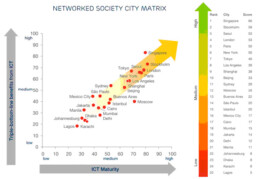
Networked Society City Index: Ciudades grandes con madurez-beneficio de las TICs
Durante el reciente Ericsson Business Innovation Summit 2011 en Silicon Valley se dio a conocer el Networked Society City Index [PDF], un estudio realizado junto con la consultoría Arthur D. Little para destacar 25 ciudades - grandes - con un alto nivel de madurez y desarrollo de las TIC. Esto apunta a ciudades capaces de gestionar aspectos relacionados con el medio ambiente, la infraestructura, seguridad pública, calidad en atención de salud y educación.
"La construcción de una sociedad conectada es uno de los grandes desafíos de nuestro tiempo para la humanidad. Aunque este análisis debe ser visto como un humilde punto de partida para explorar la relación entre las inversiones en TIC y el desarrollo sostenible, nuestra esperanza es que este informe sirva de inspiración para las ciudades que no se conforman con el statu quo", dijo Erik Almqvist, director de Arthur D. Little.
Entre las principales ciudades del índice se encuentra: Singapur, Estocolmo, Seúl, Londres, París, Nueva York, Tokio, Los Ángeles, Shangai y Beijing.
Singapur, por ejemplo, ha impulsado la innovación en e-salud, y es pionera en la gestión de la congestión de tráfico. Estocolmo considera las TIC como un habilitador importante para la investigación colaborativa y la transferencia de conocimientos; mientras que Seúl usa las TIC para iniciativas verdes de alta tecnología.
Actualmente más del 50 por ciento de la población del mundo vive en áreas urbanas, pero para el año 2030 se espera que el porcentaje crezca a un 60%. Más de 20 ciudades en el mundo se clasifican como megaciudades, es decir, ciudades con más de 10 millones de habitantes. Tokio, Bombay y Ciudad de México son ejemplos claros. En 2020, el mundo tendrá por lo menos ocho grandes ciudades más, con la mitad de todas ellas situadas en países en desarrollo.
Ciudades situadas en el norte de Europa, América del Norte y parte de Asia oriental tienen una gran trayectoria en inversión de las TIC, por consiguiente tienen una mayor madurez que se refleja en el índice.
La Ciudad de México se coloca en el lugar 16 del ranking de ciudades interconectadas, mientras que otras metrópolis latinoamericanas como Buenos Aires y São Paulo aventajan a la capital mexicana, destacando en los sitios 13 y 14 respectivamente.
Nota: La lista de ciudades conectadas usada por Networked Society City Index esta basado en la lista de Naciones Unidas de ciudades más grandes, con la adición de las capitales de las dos naciones líderes en el Networked Readiness Index 2011 (que mide los países que aprovechan las oportunidades que ofrecen las TICs) publicado por el Foro Económico Mundial.