

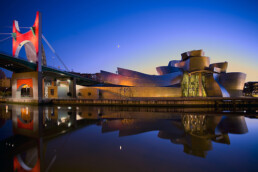
Le « Global City Report » places Bilbao comme la troisième ville la plus innovateur, après Londres et Chicago
Bilbao vient de recevoir une autre reconnaissance internationale pour sa capacité de «développer et attirer les talents." Le « Global City Report 2010 » une liste fait par une grande entreprise italienne du groupe, places à la ville de Bilbao comme la troisième ville la plus innovateur du monde, après Londres et Chicago. La classification est fondée sur l´analyse de quatre domaines: la technologie, protection de l´environnement, des attractions culturelles et de l´architecture. Les deux derniers sont les points forts de Bilbao, que dans l´avis des auteurs de l´étude, Bilbao a attendre à se transformer à un bon rythme sans sacrifier sa tradition.
Dans l´année de l´Expo universelle de Shanghai et le prix «Nobel» pour les villes, donné par les autorités de Singapour, le nom de Bilbao a également été entendu à Milan, où, mardi dernier, ont été présentées les conclusions du rapport. Le « Global City Report » est signé par deux organisations prestigieuses en Italie: Generali SGR, une des premières compagnies bancaires et d´assurance dans le pays, et l´institut de recherche indépendant Scenari Immobiliari.
Un changement «Intelligent»
Cette fois, la recherche a été axée sur l´innovation, mais pas exclusivement liée aux progrès technologiques. Si c´est le cas Bilbao n´aurait pas été mis en évidence, puisque dans ce paragraphe, il est classé à la dernière place d´un club sélect de vingt villes. Qu´est ce que c´est une valeur est « l´évolution rapide et cohérente des populations », leurs efforts pour construire un tissu économique et social pour attirer à les « nouveaux résidents, de nouvelles entreprises et, surtout, le talent créatif ». Le diagnostic a été abordé dans une portée globale et avec des indicateurs spécifiques qui vont de l´introduction de l´Internet aux réseaux de transport et l´agenda des concerts.
Bilbao a montré son dynamisme dans cette course de longue distance. Les mérites qui le sont attribuées sont les mêmes qui l´ont fait gagner d´autres prix. Dans le domaine culturel, il a remporté la troisième place, juste derrière Paris et Berlin, grâce à l´éclat de titane. « Bilbao a réussi à transformer son image de la ville urbaine et industrielle et renaît autour du musée Guggenheim, qui est devenu un symbole de la ville et l´architecture contemporaine », indique le rapport. Il est encore plus enthousiaste de la référence au développement urbain, bien que dans cette section, il occupe le septième place. « Bilbao est considéré en Europe comme un modèle de conversion intelligente », disent-ils. « En moins de vingt ans, il est venu d´être une ville portuaire industrielle à une ville de taille humaine, avec de grands espaces verts ». Dans le domaine de la durabilité, il se trouve au milieu de la table. À cet égard, que dans les zones urbaines, Toronto est le gagnant.
Bien que Bilbao ne s´impose pas dans toutes les catégories, Bilbao obtient de bonnes notes dans le classement général, peut-être parce qu´elle « à atteindre d´intégrer parfaitement l´innovation et la tradition ». La médaille de bronze est une bonne vitrine, parce que ce rapport est utilisé comme un document de travail par les grandes entreprises et les investisseurs. L´étude a été menée par deux professionnels de renom, le sociologue Saskia Sassen, Columbia University, auteur de travaux fondateurs sur la mondialisation, et Paola Gianasso, Institut de recherche Scenari Immobiliari.
Source: El Correo Digital

The Global City Report places Bilbao as the third most innovative city after London and Chicago
Bilbao has just received another international recognition for its ability to "develop and attract talent." The Global City Report 2010 -a ranking made by a major Italian business group- ranks the city of Bilbao as the third most innovative in the world, behind London and Chicago. The classification is based on the analysis of four areas: technology, environmental care, cultural attractions and architecture. The last two are the strengths of Bilbao, in the opinion of the authors of the study, Bilbao has managed to transform itself at a good rhythm without sacrificing its tradition.
In the year of the Shanghai World Expo and the ´Nobel´ Prize for cities, awarded by the Singapore authorities, the name of Bilbao has also been heard in Milan, where last Tuesday were presented the findings of the report. The Global City Report is signed by two prestigious organizations in Italy: Generali SGR real estate division, a leading banking and insurance company in the country, and the independent research institute Scenari Immobiliari.
A "smart" change
This time the research was focused on innovation, but not exclusively linked to technological advances. If so Bilbao would not have been highlighted, since in this paragraph it is ranked in the last place of a select club of twenty cities. What it is valued is "the rapid and consistent evolution´ of populations, their efforts to build economic and social fabric to attract "new residents, new businesses and, above all, creative talent". The diagnosis has been addressed in a global scope and with very specific indicators that goes from the introduction of the Internet to transport networks and concert agenda.
Bilbao has shown its dynamism in this long-distance race. The merits attributed to it are the same that have made it win other awards. In the cultural field it won the third place, only behind Paris and Berlin, thanks to the brilliance of titanium. "It managed to transform its urban and industrial city image and reborn around the Guggenheim Museum, which has become a symbol of the city and the contemporary architecture," the report reads. It is even more enthusiastic the reference to urban development, although in this section it ranks seventh. "Bilbao is considered in Europe as a model of intelligent conversion," they say. "In less than twenty years it has come from being an industrial port city to a human scale city, with large green areas." In the field of sustainability, it lies in the middle of the table. In this regard, as in urban, Toronto is the winner.
Although Bilbao does not impose in all the categories, Bilbao obtains good grades in the general classification, perhaps because it "has managed to integrate perfectly innovation and tradition." The bronze medal is a good showcase, as this report is used as a working paper by large companies and investors. The study was conducted by two renowned professionals, sociologist Saskia Sassen, Columbia University, author of seminal works on globalization, and Paola Gianasso, Research Institute Scenari Immobiliari.
Source: El Correo Digital
El Global City Report sitúa Bilbao como la tercera ciudad más innovadora tras Londres y Chicago
Bilbao acaba de recibir otro reconocimiento internacional por su capacidad de «evolucionar y atraer talento». El Global City Report 2010, un ranking elaborado por un importante grupo empresarial italiano, la sitúa como la tercera ciudad más innovadora del mundo, por detrás de Londres y Chicago. La clasificación se basa en el análisis de cuatro apartados: la tecnología, el cuidado del medio ambiente, la oferta cultural y la arquitectura. Estos dos últimos son los puntos fuertes de la capital vizcaína, que en opinión de los autores del estudio ha conseguido transformarse a buen ritmo y sin renunciar a la tradición.
En el año de la Exposición Universal de Shanghai y el ´Nobel´ de las ciudades, otorgado por las autoridades de Singapur, el nombre de Bilbao también ha sonado con fuerza en Milán, donde el pasado martes se presentaron las conclusiones del informe. El Global City Report lleva la firma de dos entidades de prestigio en Italia: la división inmobiliaria de Generali SGR, una de las principales compañías bancarias y aseguradoras del país, y el instituto independiente de estudios e investigaciones Scenari Immobiliari. Con frecuencia hacen radiografías de mercado sobre las zonas más cotizadas y una vez al año -esta es la tercera edición- elaboran estudios más complejos.
Un cambio «inteligente»
Esta vez la investigación se ha centrado en la innovación, pero no ligada exclusivamente a los adelantos tecnológicos. Si fuera así la capital vizcaína no habría destacado, ya que en este apartado figura en el último puesto de un selecto club de veinte ciudades. Lo que se valora es «la evolución rápida y coherente» de las poblaciones, sus esfuerzos por construir un tejido económico y social que atraiga «nuevos residentes, nuevas empresas y, sobre todo, talento creativo». El diagnóstico se ha abordado en un ámbito global y con indicadores muy concretos, que abarcan desde la implantación de Internet hasta las redes de transporte y la agenda de conciertos.
Bilbao ha demostrado su dinamismo en esta carrera de fondo. Los méritos que se le atribuyen son los mismos que ya le han valido otros galardones. En materia cultural ha conseguido el tercer puesto -solo superada por París y Berlín- gracias al brillo del titanio. «Ha sabido transformar su tejido urbano y su imagen de ciudad industrial renaciendo en torno al Museo Guggenheim, que se ha convertido en símbolo de la ciudad y de la arquitectura contemporánea», dice textualmente el informe. Todavía es más entusiasta la referencia al desarrollo urbano, a pesar de que en este apartado ocupa el séptimo puesto. «Bilbao está considerada en toda Europa un modelo de reconversión inteligente», dicen. «En menos de veinte años ha convertido un puerto industrial en una ciudad a escala humana, con amplias zonas verdes». En la asignatura de la sostenibilidad se sitúa en mitad de la tabla. En esta materia, al igual que en urbanismo, Toronto es la triunfadora.
Aunque no se impone en todas las categorías, Bilbao saca buena nota en la clasificación general, quizá porque «ha sabido integrar perfectamente la innovación con la tradición». La medalla de bronce es un buen escaparate, ya que este informe se utiliza como documento de trabajo por parte de grandes empresas e inversores. El estudio ha sido realizado por dos profesionales de prestigio: la socióloga Saskia Sassen, de la Universidad de Columbia, autora de trabajos fundamentales sobre la globalización, y Paola Gianasso, del instituto de investigación Scenari Immobiliari.
Fuente: El Correo Digital
Connecting classes, hospitals virtually
In a bid to improve the connectivity between areas and increase development, the Mumbai Metropolitan Region Development Authority(MMRDA) commissioner, Ratnakar Gaikwad, has decided to introduce the concept of ´smart cities´ for the Mumbai Metropolitan Region (MMR). If this plan takes off, soon there will be virtual classrooms across schools in the MMR, where students will learn from a single teacher sitting at a central point. Primary health care workers, sitting in village hospitals across the MMR, will be able to get real-time instructions from doctors sitting in a central hospital.
For this, the MMRDA will tie-up with the international Information Technology major, Cisco.
Gaikwad, who recently visited Shanghai for an Infrastructure expo, where he learnt about the company said, "The company has created a smart city connected through the Internet two hours away from Seoul in South Korea. Even Trichur, in Karnataka, has a similar project. The MMR has many villages that fall under the tribal area and are often cut-off from the rest of the developed region. Cisco will be primarily offering their services for the development of such villages".
To begin with, a pilot project will be implemented in areas where schools do not have teachers and people have to travel far to get basic healthcare. The initiative, Gaikwad said will be part of CISCO´s corporate social responsibility (CSR) and the expenses for setting up the system will be borne by Pune-based Science and Technology Park.
Source: hindustantimes
Connecting classes, hospitals virtually
In a bid to improve the connectivity between areas and increase development, the Mumbai Metropolitan Region Development Authority(MMRDA) commissioner, Ratnakar Gaikwad, has decided to introduce the concept of ´smart cities´ for the Mumbai Metropolitan Region (MMR). If this plan takes off, soon
there will be virtual classrooms across schools in the MMR, where students will learn from a single teacher sitting at a central point. Primary health care workers, sitting in village hospitals across the MMR, will be able to get real-time instructions from doctors sitting in a central hospital.
For this, the MMRDA will tie-up with the international Information Technology major, Cisco.
Gaikwad, who recently visited Shanghai for an Infrastructure expo, where he learnt about the company said, "The company has created a smart city connected through the Internet two hours away from Seoul in South Korea. Even Trichur, in Karnataka, has a similar project. The MMR has many villages that fall under the tribal area and are often cut-off from the rest of the developed region. Cisco will be primarily offering their services for the development of such villages".
To begin with, a pilot project will be implemented in areas where schools do not have teachers and people have to travel far to get basic healthcare. The initiative, Gaikwad said will be part of CISCO´s corporate social responsibility (CSR) and the expenses for setting up the system will be borne by Pune-based Science and Technology Park.
Source: hindustantimes
Connecting classes, hospitals virtually
In a bid to improve the connectivity between areas and increase development, the Mumbai Metropolitan Region Development Authority(MMRDA) commissioner, Ratnakar Gaikwad, has decided to introduce the concept of ´smart cities´ for the Mumbai Metropolitan Region (MMR). If this plan takes off, soon there will be virtual classrooms across schools in the MMR, where students will learn from a single teacher sitting at a central point. Primary health care workers, sitting in village hospitals across the MMR, will be able to get real-time instructions from doctors sitting in a central hospital.
For this, the MMRDA will tie-up with the international Information Technology major, Cisco.
Gaikwad, who recently visited Shanghai for an Infrastructure expo, where he learnt about the company said, "The company has created a smart city connected through the Internet two hours away from Seoul in South Korea. Even Trichur, in Karnataka, has a similar project. The MMR has many villages that fall under the tribal area and are often cut-off from the rest of the developed region. Cisco will be primarily offering their services for the development of such villages".
To begin with, a pilot project will be implemented in areas where schools do not have teachers and people have to travel far to get basic healthcare. The initiative, Gaikwad said will be part of CISCO´s corporate social responsibility (CSR) and the expenses for setting up the system will be borne by Pune-based Science and Technology Park.
Source: hindustantimes

Plan d´action régional pour la société de l´information
Avec la participation de 17 pays en Amérique latine et les Caraïbes attaché au Plan d´action régional pour la société de l´information a eu lieu à Montevideo, en Uruguay, la réunion préparatoire de la troisième Conférence ministérielle, qui a analysé la stratégie à long terme de la région, connue avec le nom eLAC, qui stipule que la technologie de l´information et des communications (TIC) sont des outils pour le développement économique et l´inclusion sociale.
La réunion, qui a eu lieu les 23 et 24 Septembre, a été inauguré par le Secrétaire de la Présidence de la République de l´Uruguay, Alberto Breccia, et le directeur de la Division de la production et la gestion de la CEPALC, Mario Cimoli .
Dans la réunion s´a abordé le plan régional actuel sur la société de l´information (eLAC2010) et s´examiné une nouvelle proposition pour les années suivantes (eLAC2015). Il est prévu que les accords conclus lors de cette réunion sont approuvés à la Conférence ministérielle qui se tiendra à Lima en Novembre.
Mario Cimoli exprimé un engagement fort pour le processus de la CEPALC avec eLAC. « Les TIC sont un catalyseur pour la croissance avec l´égalité, et de promouvoir l´intégration régionale », il a dit.
Cimoli a réaffirmé que l´égalité des sexes et l´équité dans la région sont deux valeurs fortes de la commission régionale de l´Organisation des Nations Unies, avec une meilleure intégration du dialogue et de co-gouvernement.
Ila souligné que des réunions comme celle-ci, sont très utiles pour le dialogue avec les pays et poru établir un consensus afin d´encourager l´approfondissement de la compréhension et la nécessité de politiques visant à promouvoir la société de l´information au niveau régional.
Pour sa part, Alberto Breccia a souligné la valeur de la réunion et la nécessité d´implémenter des Agendas Numériques et les TIC comme outils de développement, afin de faire progresser la justice sociale.
Source: Periódico La Reública, Uruguay
Regional Action Plan for Information Society
With the participation of 17 countries in Latin America and the Caribbean attached to the Regional Action Plan for the Information Society, was held in Montevideo, Uruguay, the Preparatory Meeting for the Third Ministerial Conference, which analyzed the long-term strategy of the region, known as eLAC, which states that the information technology and communications (ICT) are tools for economic development and social inclusion.
The meeting, which took place on 23 and 24 September, was inaugurated by the Secretary of the Presidency of the Republic of Uruguay, Alberto Breccia, and the director of the Division of Productive and Business Development of the Cepal, Mario Cimoli.
During the meeting it was presented the current regional plan on the Information Society (eLAC2010) and it was discussed a new proposal for the following years (eLAC2015). It is expected the decisions taken at this meeting to be approved at the Ministerial Conference to be held in Lima in November.
Mario Cimoli expressed the strong commitment of Cepal to the ECLAC process. "ICT is a catalyst for growth with equality, and promote regional integration," he said.
Cimoli reaffirmed that gender equality and equity in the region are two strong values of the regional commission of the United Nations, along with the improvement of the integration through dialogue and co-government.
He remarked that meetings like this are very helpful for the dialogue between countries and for building consensus that encourage the deepening of understanding and need for policies to promote the information society at regional level.
Alberto Breccia highlighted the value of the meeting and the need to empower Digital Agendas and ICT as tools for development, in order to make progress on social justice.
Source: Periódico La Reública, Uruguay
Plan de Acción Regional para la sociedad de la información
Con la participación de 17 países de América Latina y el Caribe adheridos al Plan de Acción Regional para la sociedad de la información, se realizó en Montevideo, Uruguay, la Reunión Preparatoria para la Tercera Conferencia Ministerial, donde se analizó la estrategia de largo plazo para la región, conocida como eLAC, que plantea que las tecnologías de la información y de las comunicaciones (TIC) son instrumentos de desarrollo económico y de inclusión social.
El encuentro, que se llevó a cabo el 23 y 24 de setiembre, fue inaugurado por el secretario de la Presidencia de la República Oriental del Uruguay, Alberto Breccia, y el director de la División de Desarrollo Productivo y Empresarial de la Cepal, Mario Cimoli.
En la cita se abordó el actual plan regional sobre la sociedad de la información (eLAC2010) y se discutió una nueva propuesta para los años siguientes (eLAC2015). Se espera que los acuerdos tomados en esta reunión sean aprobados en la Conferencia Ministerial a realizarse en Lima, en noviembre próximo.
Mario Cimoli manifestó el gran compromiso de la Cepal con el proceso eLAC. "Las TIC son un detonador para crecer con igualdad y promover la integración regional", indicó.
Cimoli reafirmó que la igualdad y la equidad en la región son dos valores muy fuertes de esta comisión regional de las Naciones Unidas, junto con el mejoramiento de la integración a través del diálogo y el co-gobierno.
Destacó que reuniones como estas son muy provechosas para el diálogo de los países y la generación de consensos que estimulen la profundización de la comprensión y necesidad de políticas para promover la sociedad de la información a nivel regional.
Por su parte, Alberto Breccia resaltó el valor de la reunión y la necesidad de potenciar a las agendas digitales y a las TIC como herramientas para el desarrollo, en aras de lograr avances en la justicia social.
Fuente: Periódico La Reública, Uruguay