

Walking the talk: Creating people-centred cities: a turning point in Rabat?
At the first side event at the UCLG Congress organized by the UCLG Urban Strategic Planning, the Committee on mobility and digital and knowledge-based cities, and the City of Rabat´s Planning Department, history was made when Walk 21, an international NGO conducted its first walking audit in Africa. The mandate of Walk 21 of creating a culture and community where people choose to walk, is aligned with city strategies to promote walking and its interface with public transportation and is also consistent with the UCLG vision of more integrated, sustainable and just cities.
In the morning seminar held on October 1st before the walking audit, participants learnt that two-thirds of the entire city population in Rabat uses walking as a mode of transport and great efforts have been made by the city leadership to promote walking. Interestingly it was also discovered that 63 percent of all internal trips in Bilbao today consist of walking. Bilbao´s successes was achieved by a strong policy framework to promote a more human scale of development. Inspired by these insights from political leadership, we then conducted the walking audit in downtown Rabat. This experiential learning exercise was an eye-opener for all those that attended, and it helped us understand the city from the perspective of the pedestrian.
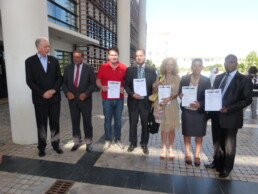
It was encouraging to see political leaders from the cities of Bilbao, Inhambane, Porte Alegre, Durban and Rabat, literally take the first step together earlier this week towards recommitting themselves to create cities that put PEOPLE at the center of development. Led by the Mayor of Durban, they each signed the International Charter for Walking.
The second step was taken later in the week, again led by the political Co-Chairperson of the Urban Strategic Planning Committee who was given an opportunity to make an input into the UCLG Executive Bureau. At this meeting he urged all members of the Executive Bureau to promote this agenda and encouraged all city partners to pledge support for the Charter.
NOTE: The full Charter can be found and signed at www.walk21.com/charter The International Charter for Walking identifies the needs of people on foot and provides a common framework to help authorities refocus their existing policies, activities and relationships.

Creando ciudades centradas en las personas: ¿Un punto de avance en Rabat?
En el primer evento paralelo del Congreso Mundial de CGLU organizado por las Comisiones de Planificación Estratégica Urbana, Movilidad y Ciudades Digitales y del Conocimiento con el apoyo del Departamento de Planificación de la Ciudad de Rabat, se hizo historia cuando Walk21, una ONG internacional, llevó a cabo su primera "Auditoría del caminar" en áfrica. El objetivo de Walk21 de crear una cultura y comunidad en la que las personas elijan caminar, está alineado con la estrategia de las ciudades de impulsar los traslados a pie y si interrelación con el transporte público. Así mismo, coincide con la visión de CGLU de crear ciudades integrales, sostenibles y justas.
En el seminario celebrado la mañana del 1 de octubre antes de llevarse a cabo la auditoría, los participantes pudieron conocer que dos tercios de la población de la Ciudad de Rabat, realizan sus traslados a pie y se han llevado a cabo grandes esfuerzos por parte de la ciudad para promover el caminar. Por otro lado, la Ciudad de Bilbao también compartió con los asistentes, que el 63 por ciento de los traslados internos llevados a cabo en la ciudad se realizan a pie. El éxito de Bilbao radica en el fuerte compromiso llevado a cabo por el gobierno de la ciudad de promover el desarrollo de una ciudad a "escala humana".
Inspirados por estos ejemplos de liderazgo político, se llevó a cabo la auditoría del caminar en el centro de la ciudad de Rabat. Este ejercicio de aprendizaje experimental, sirvió para abrir los ojos a los participantes, y ayudó a que entendieran la ciudad desde la perspectiva del peatón.
Fue alentador, el ver a líderes políticos de las ciudades de Bilbao, Inhambane, Porto Alegre, Durban y Rabat, literalmente dar el primer paso juntos hacia el refuerzo del su compromiso para crear ciudades que pongan a las PERSONAS en el centro del desarrollo. Liderado por el Alcalde de Durban, cada una de las ciudades asistentes, firmo la "Carta Internacional del Caminar".
El Segundo paso se llevó a cabo, más tarde a lo largo de la semana. Nuevamente, bajo el liderazgo político del Copresidente de la Comisión de Planificación Estratégica Urbana, se dio la oportunidad, de presentar los resultados de la auditoría al Bureau Ejecutivo de CGLU. En ésta reunión, se hizo un llamamiento a los miembros del Bureau Ejecutivo a que promovieran esta agenda y se animó a las ciudades difundir el apoyo a la Carta.
NOTA: Las ciudades interesadas en firmar la carta, pueden encontrar el documento completo en www.walk21.com/charter La Carta Internacional del Caminar, identifica las necesidades de las personas que se trasladan a pie y proporciona un marco común para ayudar a las autoridades a reconducir sus políticas, actividades y relaciones existentes.