


La cumbre de Bilbao concluye que los retos de la web no son técnicos
Los grandes retos para el porvenir de la web no son técnicos. Esa es la principal conclusión que ha arrojado la cumbre Bilbao Web Summit, que ayer cerró sus puertas con la entrega del premio Dama al inventor de la web, Tim Berners-Lee. "La política pública, la regulación, los modelos de negocio, los intereses privados e incluso la inercia cultural son los obstáculos más importantes para el desarrollo de Internet, más incluso que cualquier protocolo técnico", reza el comunicado conjunto difundido por los expertos reunidos en la cita.
"El cambio y el compromiso tienen que llegar por parte de los usuarios, pero también de las empresas y los Gobiernos si queremos hacer realidad el sueño de la Internet del futuro", añade.
Igualmente, señala que la web "supone una enorme oportunidad para los emprendedores para crear nuevas empresas y que las ya existentes generen nuevos valores. Para los usuarios representa la ocasión de establecer relaciones nuevas y más fuertes", apunta. En cualquier caso, la la mujer más influyente de Silicon Valley, Chris Shipley, cofundadora de Guidewire Group, recordó que "las personas son más importantes que las tecnologías".
La mesa redonda sobre la relación entre los Gobiernos e Internet se convirtió en un alegato de todos los participantes en defensa de las ventajas de compartir información gubernamental con los usuarios de la red. Jeanne Holm, arquitecta de la NASA y responsable de la aplicación Data.gov, señaló que esta herramienta es capaz de "impulsar la economía" y que lo importante no es colgar los datos sin más, si no "hacerlos comprensibles".
"Las administraciones públicas pueden encontrar en Internet los perfectos aliados que hagan realidad la utopía de cercanía, transparencia y participación", resaltó la portavoz del Gobierno vasco, Idoia Mendia.
Fuente: El País

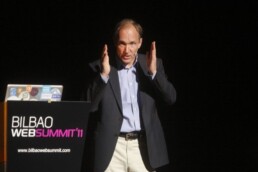
Tim Berners-Lee el padre de la Web, en la Bilbao Web Summit
Sir Tim Berners-Lee asegura en Bilbao que la conectividad reducirá las diferencias de desarrollo. El creador de la web destaca que internet es una potente herramienta de resolución de problemas
"Ahora, cuando el 20% de la población mundial se conecta a internet y sus vidas funcionan más eficientemente gracias a la red, te preguntas qué pasa con el 80% restante. Por eso desde el Consorcio W3C decidimos crear una fundación que analiza cómo debe ser la web para que atienda y dé servicio a toda la humanidad", explicó ayer en Bilbao sir Tim Berners-Lee, el creador del lenguaje que ha hecho posible internet tal y como lo conocemos hoy. Berners-Lee, que ofreció una conferencia abierta al término de la primera jornada de Bilbao Web Summit, animó a los asistentes y a las instituciones a volcar datos e información, porque eso "enriquece la web" y dijo que debemos pensar "en qué podemos hacer para que la gente se incorpore a la sociedad de la información".
Berners-Lee, que fue presentado por Xabier Uribe-Etxebarria, fundador y director ejecutivo de Anboto, explicó a un numeroso público que antes de la era de la información las grandes diferencias entre la población mundial estaban en el acceso al agua potable o la sanidad, pero ahora, con el desarrollo tecnológico, la diferencia entre pertenecer al 20% de la población que está conectado o al 80% que no lo está "es enorme". El creador del lenguaje HTML y del protocolo HTTP afirmó que "internet ha hecho que la separación entre ambos grupos sea aún mayor, pero también es cierto que reducir la brecha del desarrollo es más fácil si tienes conectividad", porque en internet puedes encontrar soluciones e información que pueden ayudar a establecer redes de saneamiento o atención sanitaria, también te permite exponer los problemas y recaudar fondos. De ahí que el Consorcio W3C, que reúne a las principales empresas y entidades de internet, y que estos días celebra en Bilbao una de sus dos sesiones anuales, trabaje no solo en cuestiones técnicas, sino también en la universalidad y la accesibilidad de la red. "Estudiamos -dijo Tim Berners-Lee- qué clase de web tenemos, cómo queremos que sea y también cómo utilizarla para hacer que el mundo sea un sitio mejor".
un cielo de leds La intervención de sir Tim Berners-Lee en el auditorium del Palacio Euskalduna fue seguida con mucha atención por los cientos de asistentes a la cumbre de la web, por empresarios y directivos, muchos estudiantes y personas sin vinculación directa con los negocios de internet pero que, sin duda, pertenecen a ese 20% de la población al que la red ofrece servicios, ayuda e información. Una muestra evidente de que era un público conectado llegó al final del acto cuando Xabier Uribe-Etxebarria pidió a todos que encendieran las pantallas de sus móviles y dispositivos para crear un cielo de estrellas leds.
En su exposición, Berners-Lee explicó el trabajo que desarrolló hace veinte años para lograr la interconexión de ordenadores y archivos y apuntó que hace dos años comprobó que la web "funciona bien", pero que hacía falta tener acceso a más datos, así que empezó a animar a la gente para que introdujera información y creó un sistema de estrellas para premiar esas contribuciones de información a la red. El presidente de W3C señaló también que internet "es una potente herramienta de colaboración" y que "una masa de humanidad interconectada será mucho más fuerte y tendrá más posibilidades de resolver problemas demasiado grandes, como el sida o el cambio climático".
En la jornada de ayer de Bilbao Web Summit, se debatió sobre eBanking, eHealth, eLaw y eEducation. Por la mañana, en la presentación oficial de la cumbre participaron, además de Tim Berners-Lee, Chris Shipley, Xabier Uribe-Etxebarria y Jeffrey Jaffe, en representación de los organizadores, el alcalde de Bilbao, Iñaki Azkuna, el secretario general de Innovación del Ministerio de Ciencia, Juan Tomás Hernani, y el viceconsejero de Innovación y Tecnología del Gobierno vasco, Juan Goicolea. Por el lado institucional, Iñaki Azkuna quiso destacar que en la jornada que celebraba el Día de Internet, quien está considerado como el padre de la web "no está en Nueva York, ni en París ni en Tokio, está en Bilbao". Juan Tomás Hernani afirmó que "internet no es un canal sino un gran espacio de la economía" y consideró necesario "entender los procesos de negocio dentro de la red".
Fuente: Deia
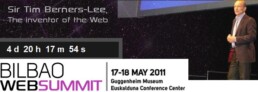
BILBAO ACOGE LA CUMBRE MÁS IMPORTANTE DE EUROPA SOBRE INTERNET Y NUEVAS TECNOLOGÍAS
Bilbao, 9 de mayo de 2011.- Los mayores expertos mundiales en el campo de Internet se reúnen en apenas unos días en Bilbao para debatir sobre el futuro de la Red. La cita, bautizada con el nombre de Bilbao Web Summit, tendrá lugar los próximos 17 y 18 de mayo en el Palacio Euskalduna. Todavía quedan plazas libre para inscribirse en esta cumbre, considerada como la más importante de toda Europa sobre Internet y nuevas tecnologías. De esta forma, las personas interesadas pueden inscribirse a través de www.bilbaowebsummit.com.
Este encuentro reunirá a los mayores expertos mundiales en esta temática, entre ellos Sir Tim Berners-Lee, considerado padre de la Web y creador del lenguaje HTML y del protocolo HTTP, y Chris Shipley, reconocida como la mujer más influyente de Silicon Valley. Junto a ellos, los principales expertos en Internet, empresarios y profesionales de distintos sectores de negocio analizarán el presente de la Red y definirán las grandes líneas de actuación que permitirán diseñar la próxima generación de Internet.
Junto a estos ponentes, la cinta contará con Jean M. Holm (Arquitecta de Conocimiento de la NASA), Xabier Uribe-Etxebarria (fundador y consejero delegado de Anboto Group y promotor del evento), Brian Wong (de Digg), Peter Redshaw (Vicepresidente de Gartner); Idoia Maguregui (CIO de Bankinter) o Álex Cruz (Consejero Delegado de Vueling).
Sentar las bases para el futuro de la web
Además, entre el 16 y el 19 de mayo, la Comisión Consultiva del W3C (World Wide Web Consortium) celebrará distintas reuniones en Bilbao para sentar las bases de la Red para los próximos años. Los criterios que se fijen en Bilbao afectarán a los futuros servicios de banca on-line, administración electrónica, telemedicina, educación digital, medios digitales y comercio por Internet.
Bilbao Web Summit es una iniciativa impulsada por Xabier Uribe-Etxebarria, fundador de la empresa vasca Anboto, reconocida este mismo año como mejor nueva compañía tecnológica del mundo, y de W3C, entidad que regula los estándares web a nivel mundial. El evento cuenta ya con el apoyo del Ayuntamiento de Bilbao, el Gobierno Vasco además de con el patrocinio de entidades tales como Biscaytik, BBVA, Euskaltel y Gartner.
Una de las principales novedades de la Bilbao Web Summit será la publicación de las conclusiones acordadas por los participantes en esta cumbre mundial. Este documento, pionero y único en su género, servirá como hoja de ruta para anticipar las tendencias de desarrollo de Internet como ámbito de toma de decisiones a distintos niveles: banca on-line, administración electrónica, telemedicina, educación digital, medios digitales y comercio por Internet.
La elección de Bilbao para esta cumbre mundial sobre el futuro de Internet está estrechamente vinculada al nivel de desarrollo alcanzado por Euskadi y la Villa y su área de influencia en materia de Internet y uso de las TIC y, de forma muy particular en el ámbito de las aplicaciones lingüísticas y semánticas, gracias en gran medida a las necesidades surgidas por el carácter bilingüe de la sociedad vasca.
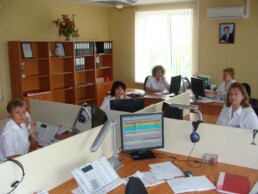
The City of Stavropol shares its experience “Safe Stavropol”
The City of Stavropol in Russia has developed an Integrated System of Operational Dispatch Control (IODCS) on the basis of the Stavropol Single Duty and Dispatch Service (SDDS) and a video surveillance system (CCTV) at municipal educational institutions and public places
The main objectives of the project are:
- Twenty-four hour collection, processing and provision of information on emergency situations, forecasts and trends of their development and consequences, forces and resources involved in prevention and recovery of emergencies;
- Operational management of the forces and means in carrying out activities for emergency response and recovery of emergencies;
- Communication between the city government units of the Stavropol Regional territorial subsystem of the unified state system for prevention and recovery of emergencies (hereinafter RSES), forces and funds involved in emergency response;
- Introduction of the technical security control facilities on the basis of video surveillance systems at municipal educational institutions and public places.
For further information visit the section "Best practices"
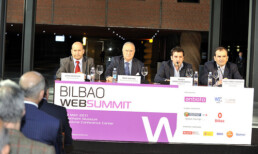
The present and future of internet was debated at the Bilbao Web Summit
On the 17th and 18th of May, 2011 took place in the City of Bilbao the "Bilbao Web Summit". A global event that brought together, world-class experts, in the field of internet, to debate on the future of the net.
The Bilbao Web Summit, counted on with the support Bilbao City Hall, and it represented the most important Summit in Europe on the internet and new technologies, and it gathered the most important experts in the field, among them Sir Tim Berners-Lee, considered as the father of the Web and creator of the HTML language and the HTTP protocol, and Chris Shipley, known as the most influent woman of the Silicon Valley. Along with them, the main internet experts, key business people and professionals from the sector, analyzed the present of the net and established the mail action lines that will define the next Internet generation.
Bilbao hosted discussions about the future of the Web for a week. From the 16th to the 19th of May, 2011 the W3C Advisory Committee met in Bilbao to mark the bases of the Web for the next years. The criteria established in Bilbao will affect future services of on-line banking, electronic administration, telemedicine, digital education, digital media and digital commerce.
One of the main features of the Bilbao Web Summit is the publication of the conclusions agreed by the participants. This unique document, will serve as Road map to advance the tendencies in the development of internet.
The selection of Bilbao for this World Summit on the future of internet is closely related to the high-level of development reached by the Basque Country and the City of Bilbao in the field of Internet and the use of ICT.
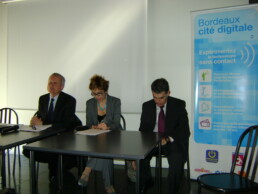
The City of Bordeaux a new member to the Committee
The City of Bordeaux has taken the opportunity of the Digital Week to officially announce on the 22nd of March its incorporation to the Committee of Digital and Knowledge-based Cities.
The City of Bilbao that chairs the Committee was invited to the official presentation and is pleased to count on with the participation of the City of Bordeaux in the Committee.
The City of Burdeaux has been developing during the last years its "Cordeux Digital City" Project, to boost the digital development through an innovative dynamic that is able to achieve a more sustainable life in the cities, more alive and with more solidarity.
As part of this initiative, the City of Bordeaux has organized from the 21st to the 26th of March 2011 the Digital Week. A week that is integrated by workshops, debates and mixed events that will allow to debate about the impact of the developments of digital projects in the cities.

The European Commission launches public consultation on eSignatures and eIdentification
In order to tackle low levels of consumer and business confidence in online transactions, the European Commission is asking citizens and other interested parties how electronic signatures and electronic identification (eID) and authentication can help the development of the European Digital Single Market. Currently, difficulties in verifying people´s identities and signatures are a significant factor holding back the development of the EU´s online economy. Electronic signatures and electronic identification (eID) and authentication can be an important tool to enable both users and providers to rely on secure, trustworthy and easy-to-use online services but must work in all Member States to be effective. The results of this consultation will feed into the Commission´s review of the existing eSignature Directive and the preparation of a planned initiative on the mutual recognition of electronic identification and authentication. Boosting e-commerce, e-business, and making it easier to undertake administrative procedures online in the Single Market are important aspects of the Digital Agenda for Europe (see IP/10/581, MEMO/10/199 and MEMO/10/200). The online consultation runs until 15 April 2011.
Neelie Kroes, European Commission Vice President for the Digital Agenda, said: "I welcome everybody´s views on how we can best verify people´s identities and signatures when we buy, sell or undertake administrative procedures online that need to be highly secure. I want to help all Europeans get online without feeling that they will fall victim to data frauds or scams. "
Low levels of consumer and business confidence when making transactions online are one factor holding back the development of the EU´s online economy. Relying on secure, trustworthy and easy to use online services is vital for a strong and healthy European Digital Single Market. To tackle these issues, the Digital Agenda for Europe nnounced a review of the eSignature Directive (1999/93/EC) and an initiative on the mutual recognition of eIdentification and eAuthentication.
Everyone is invited to participate in the consultation by sharing their views on how electronic identification, authentication and signatures can contribute to deliver the European Digital Single Market and on possible measures to create optimal conditions to stimulate its progress.
The public consultation seeks feedback on:
- citizens´ and businesses´ expectations of EU rules on electronic signatures, identification and authentication. In particular, the general usefulness of eSignatures and eID user and specific business sector needs, socio-economic benefits, fields of application, potential additional trust-building services (e.g. time stamping), mobile usage and the legal recognition of electronic consent by clicking "I accept"
- the ICT sector´s view on how eSignatures can be best tailored to face the forthcoming challenges triggered by technological progress. Interested parties are asked to express their views on existing barriers, security requirements, potential grading of security levels, and expectations on standardisation
- the common set of principles which should guide the mutual recognition of eIdentification and eAuthentication in Europe, as well as considerations for economies of scale by allowing national eID systems, benefiting users across EU borders, and cross-sector uses in the public and private sectors
- the potential contribution of research and innovation to the development of new eIdentification and eSignatures authentication, such as alternatives to Public Key Infrastructure (PKI) currently in use for the easy management of electronic signatures, and eID-cards.
The Commission will analyse the responses to the consultation as part of its review of the eSignature Directive and the preparation of an initiative on the mutual recognition of eIdentification and eAuthentication.
Pilot project
The Commission is also already supporting a large scale pilot project called "STORK" (Secure idenTity acrOss boRders linKed) to enable cross-border recognition of eID systems and easy access to public services in 18 European countries (see https://www.eid-stork.eu for details). The project aims to enable EU citizens to prove their identity and use national electronic identity systems (passwords, ID cards, mobile phones and others) throughout the EU, not just in their home country.
For more information
The consultation document is available on:
http://ec.europa.eu/yourvoice/ipm/forms/dispatch?form=eid4&lang=en
Neelie Kroes´ website:
http://ec.europa.eu/commission_2010-2014/kroes/
Digital Agenda website:
http://ec.europa.eu/information_society/digital-agenda/index_en.htm
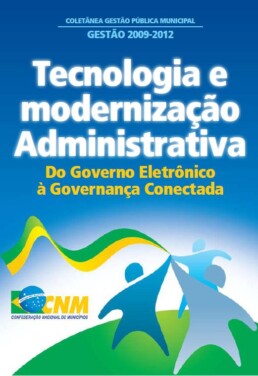
The CNM publishes a reflection on technology and administrative modernization
The National Confederation of Municipalities of Brazil (CNM) that holds the Vice-presidency of the Committee has recently published a reflection on municipal management in the matter of "Technology and administrative modernization: from the electronic Government to the connected governance".
The objective of the publication is to present key questions and pertinent considerations that can help the public manager to support their technological decisions.
The document presents the last subjects treated in Geneva on the evolution in the government, through real examples of the Brazilian municipalities and worldwide, and it identifies directives on how to guarantee the maturity of discharge in the development process and management of the technology.
The publication does not try to have all the answers, but it tries to be a guide who helps the new administrators so that they are able to make the correct questions against the challenges that will find in their mandate.
The guide is accessible in Portuguese in the section of documents of the page Web of the committee.
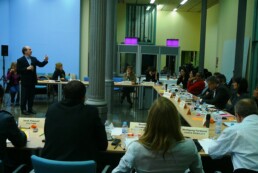
The Secretariats of the Committees meet in Barcelona to contribute to the strategic planning of UCLG
On the 22nd and 23rd of February took place in the Head Quarters of the World Secretariat the annual meeting of the secretariat of the Committees.
During 2010 UCLG started consultations for a redefinition of strategic priorities of our organization. This exercise that seek to promote contributions from all the partners in the process of t the Strategic planning of UCGL, started with consultations of the Secretaries General of the UCLG Sections and the UCLG Advisory Board.
This dynamic Workshops Addressed to the Secretariats of the Committees and Working Groups was part of this process. The workshop revised the results of the exercise and decisions to date and gathered concrete inputs on the long term general work programme of the organization, the priorities and the products to be developed. The workshop also provided the opportunity to share the progress made in the implementation of the work programmes of the different committees and working groups.
We encourage the members of the Committee to take part of the redefinition process of the priorities of UCGL by answering the following survey: UCLG Survey

The safe mobile payment becomes reality at the Mobile World Congress
The safe mobile payment has become a reality that can be exploited commercially when banks and operators so desire, as revealed at Mobile World Congress, held in Barcelona.
GAD, a multinational company specializing in the safety and well known in the world of money by making legal tender notes, presented their solutions to pay by phone safely via NFC contactless technology, which apparently has emerged as the standard to be used anywhere in the world. But it also provides security when conducting financial transactions with sophisticated systems that protect data and communications between machines.
The company, which is used by some governments to encrypt mobile phone conversations of senior executives, also shows this technology in the MWC. These security solutions to address all the changes that are occurring in the mobile world with the advent of broadband, which allows more sophisticated services that require data protection.
Dual core
Other highlights include dual-core processors, which comes to smart phones, computers becoming sophisticated, closer to the world of computing. The first consequence is that the market for high-end phones will be downgrading to reach the general public, say executives from Qualcomm, the largest multinational chips in the mobile world.
These mobile processors make faster, more efficient and longer battery life. Qualcomm executives say their dual-core processor is a fundamental difference: each of its CPU works separately, so that only combined if necessary. So there is more efficiency and battery saving, they say.
This manufacturer, which calls its processors with the name of Snapdragon, has taken another step in this conference to introduce the quad-core processor that will allow using devices and heated less and have more features and lesser extent.
Source: Reuters